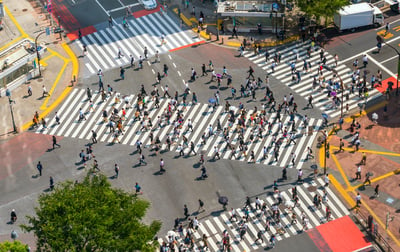
The business travel industry is evolving fast. From AI-driven personalisation and cost consolidation to flex-first living and duty of care, corporate travel is no longer just about moving people from A to B.
To understand what 2026 really looks like on the ground, we asked our client-facing teams what they’re hearing directly from travel managers and hospitality partners in their day-to-day conversations.
Here are the biggest trends shaping corporate travel and accommodation in 2026:
-
-
AI-powered personalisation
Corporate travel faces industry disruption
The corporate travel landscape is undergoing significant disruption as mergers, partnerships, and acquisitions reshape the industry.

“The merger of two of the biggest TMCs, Amex GBT and CWT, and their partnership with Concur is going to put further pressure on smaller TMCs. I think we'll see more acquisitions occur in the travel landscape to solidify offerings and other TMCs' value.”– Alex de Vaux, SVP of Client Partnerships - Americas
Geopolitical volatility, traveller risk & duty of care
Geopolitical uncertainty is increasingly shaping corporate travel strategies, making risk management and traveller safety top priorities.
In response, companies are placing a sharper focus on proactive safety measures to ensure employees are safe and secure throughout every trip.
“One of the biggest themes I’m hearing from clients is a heightened focus on traveller safety and duty of care. Companies want to be confident that employees not only travel smoothly, but feel secure and supported from departure through arrival.”– Kerri Amman, Client Development Manager
AI-powered personalisation
Operational disruption, shifting border policies, and economic uncertainty are pushing companies to rethink how they plan and manage travel programmes. One key focus is leveraging AI to enhance personalisation, improve efficiency, and support smarter decision-making.
“We’re seeing AI increasingly used to drive personalisation, based on guest information. We’re also seeing travel managers and bookers use data to make more informed choices when it comes to corporate accommodation management.” – Beverly King, VP of Client Partnerships
Hospitality partners are also adapting, using AI to transform the stay experience.
“Hospitality partners seem to be adapting by deploying agentic AI to handle hyper-personalised, non-linear booking journeys and using data-driven 'attribute-based selling' to let guests customise specific room features like high-speed connectivity setups or wellness kits. To stay competitive, those who haven't yet adapted must bridge the gap between automation and the 'human touch' by reinvesting in local community curation and flexible inventory management that allows for seamless transitions between short-term and extended stays.” – Emma Schweder, Hospitality Growth Manager
Cost control and the rise of serviced apartments
“Overall, business travel budgets are expected to rise, as the value of meeting and working face-to-face continues to outweigh the impact of virtual meetings.” – Beverly King, VP of Client Partnerships
Cost optimisation remains a core priority, especially as economic uncertainty and travel costs continue to climb.
These financial pressures are driving a clear shift in accommodation patterns.
The shift is also being driven by longer-term stays and “flex-first” policies.
“Corporate accommodation is moving away from traditional hotels toward high-quality serviced apartments and longer-stay options. At AltoVita, we’re seeing strong demand for flexible, fully self-contained spaces that provide consistency, comfort, and a ‘home-like’ experience.” – Andraž Šereš, Sourcing Manager - EMEA
The trend is evident in APAC as well.
“Trends are changing. People previously preferred hotels, but are now switching to serviced or hotel apartments. Hospitality partners are quickly adapting to meet evolving guest needs.” – Saurabh Arora, Senior Hospitality Growth Manager - APAC
Shifting travel corridors and emerging destinations
Cost optimisation and strategic project planning are driving a noticeable shift in corporate travel patterns.
Sustainability & wellbeing take centre stage
Alongside this geographic diversification, sustainability and wellbeing are becoming central priorities for corporate travel.
Corporate travellers themselves are advocating for greener choices and companies are responding accordingly.
Wellbeing is also a growing focus in 2026, with companies recognising its impact on productivity and employee experience while on the move. Concepts like “quietcation” or “hushpitality” are gaining attention, providing safe, quiet spaces for travellers to recharge amid busy schedules.
Flexibility, Choice, and Evolving Corporate Accommodation
Corporate travel programmes are increasingly focusing on flexibility, choice, and accommodation strategy. We’re seeing more RFPs as companies consolidate spend across travel and mobility, while prioritising cost, compliance, duty of care, and employee experience.
Alongside consolidation, there is a clear shift toward flexible policies that allow employees choice while maintaining programme oversight.
Hospitality partners are adapting by professionalising services and aligning offerings with corporate priorities.
Future-proof your corporate accommodation programme in 2026 with AltoVita.
Streamline bookings, optimise spend, access real-time data or browse from our 7 million+ vetted properties worldwide.