For too long, accessibility requirements in temporary accommodation have been treated as an afterthought: captured in free-text notes, communicated through emails, or discovered only after a property has already been selected.
For guests with mobility, sensory, neurodivergent, medical, or wellbeing needs, this creates unnecessary uncertainty and risk. A home that is unsuitable can impact comfort, independence, productivity, and the overall success of a stay. It can also lead to unexpected costs, including last-minute relocations, cancelled bookings, and the time required to find an alternative property that genuinely meets the guest’s needs.
The Accessibility Information gap
The challenge is not simply finding accessible properties. It is creating a reliable way to understand individual needs, communicate them clearly, and validate that a property genuinely meets those requirements.
Recent independent research from the University of Texas at Dallas highlights the scale of this challenge: while one in six people globally lives with a disability, fewer than 5% of accommodation options are accessibility-rated. The research found that many providers still rely on inconsistent, self-declared accessibility information rather than structured, verified data.
The same research assessed AltoVita as the only platform studied to embed structured accessibility requirements into the booking journey, enabling hospitality partners to confirm property-level accessibility features when responding to accommodation requests.
Moving accessibility from a request to a reliable workflow
Accessibility looks different for everyone. With AltoVita’s Accessibility feature, accessibility and comfort needs are embedded into the accommodation journey, from accommodation request to booking, helping teams capture requirements, validate suitability, and make more informed decisions.
AltoVita’s feature allows temporary accommodation teams to capture requirements across six categories:
- Mobility & Physical Accessibility
- Sensory Accessibility
- Neurodiversity & Cognitive Support
- Medical Needs
- Mental Health & Psychological Needs
- Dietary & Religious Needs
Teams can select relevant requirements using structured options and add further context where needed. Importantly, the process focuses on accommodation needs rather than medical information, allowing guests to communicate what support they require without needing to disclose diagnoses.
These requirements become part of the core housing criteria from the very beginning.
How it works
Step 1: Capturing accessibility needs at the request stage
When creating a housing request on our platform, users can select accessibility and comfort requirements using multi-select options across the six categories.
Additional comments can be added where more context is helpful, ensuring hospitality partners understand what matters most without requiring sensitive personal details.
.png?width=2938&height=1576&name=Accessibility%20Booking%20Request%20(1).png)
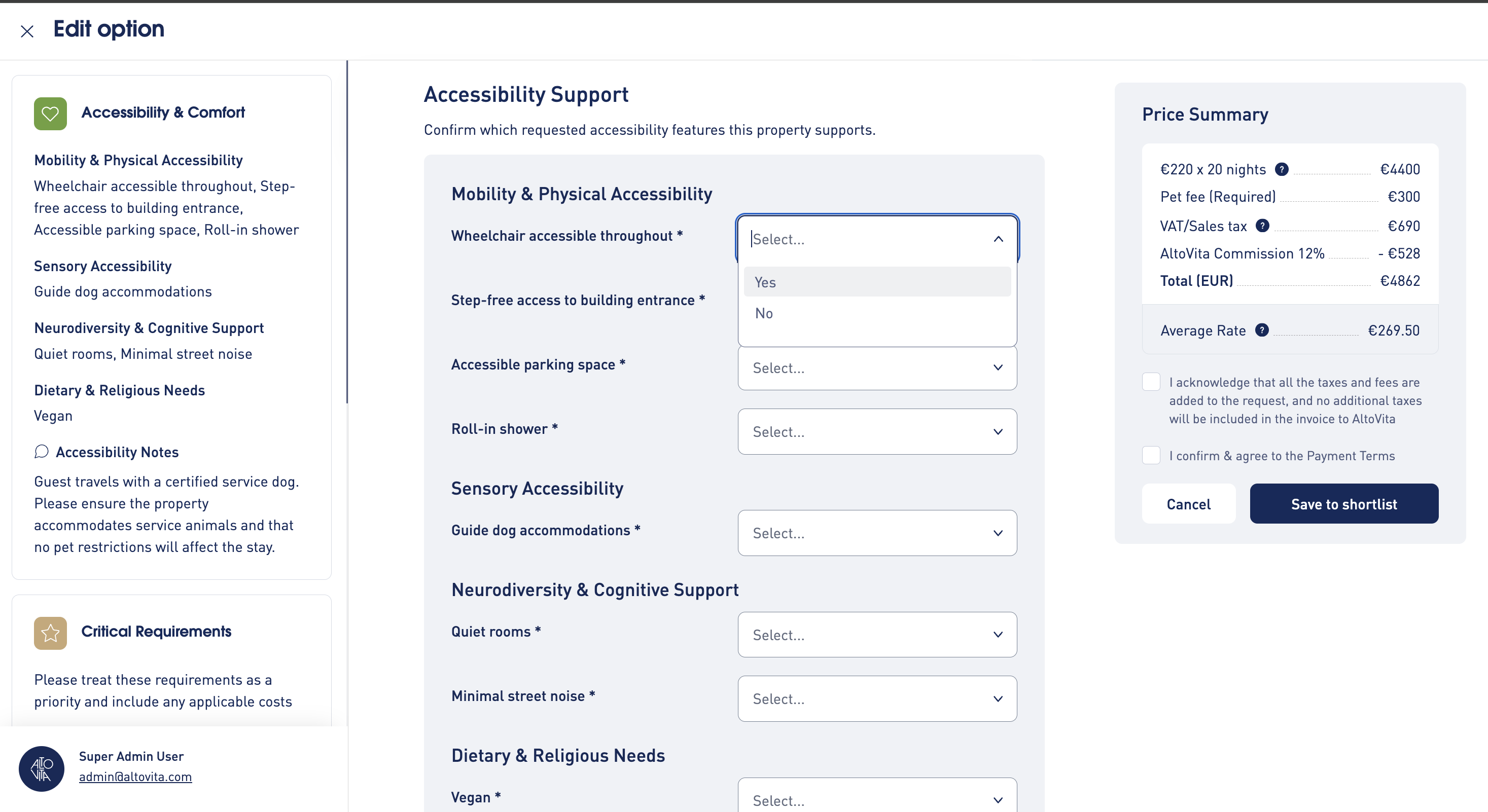
Step 2: Hospitality partners validate requirements at property level
During the bidding process, hospitality partners can see accessibility requirements clearly displayed within the Housing Request panel as structured tags.
For each property, suppliers will need to confirm which requirements are met and provide supporting notes where needed (e.g. "roll-in shower confirmed", "elevator width 120cm").
Step 3: Teams compare properties with confidence
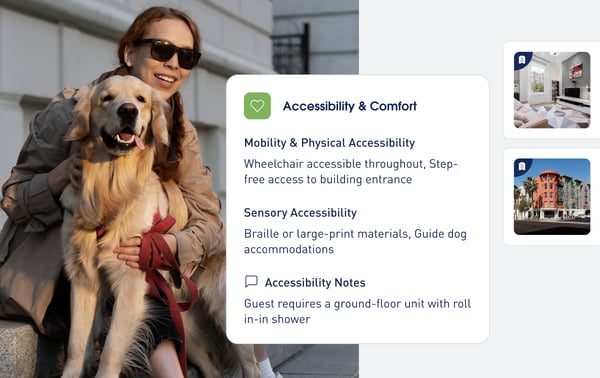
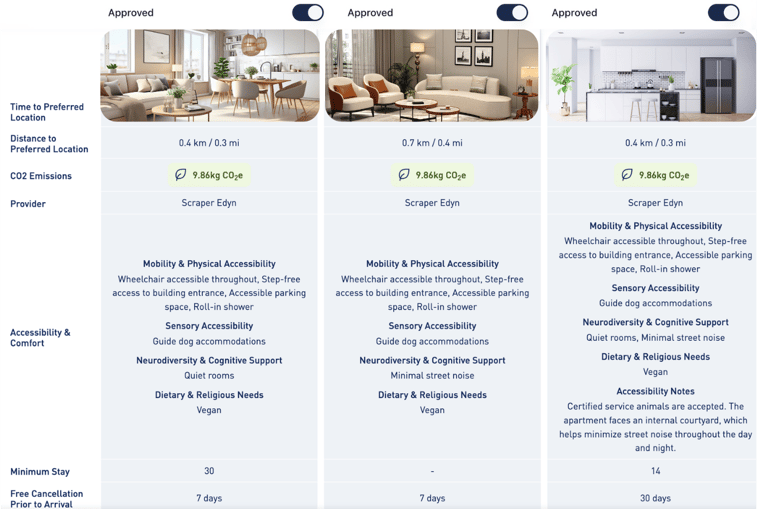
When property shortlists are presented to booking teams, the Accessibility & Comfort card provides a clear breakdown of confirmed features by category, including relevant notes from hospitality partners.
Instead of piecing information together across multiple conversations, teams can compare shortlisted properties consistently and make more informed decisions based on verified accessibility information.
Step 4: Guests make an informed choice
Finally, when reviewing property options, employees and guests can view a dedicated Accessibility & Comfort section both in the map view and on individual property pages. Confirmed features and operational notes are displayed clearly, giving guests visibility into what each home offers.
This creates a more inclusive experience and empowers guests to make the choice that best meets their needs.
.png?width=909&height=495&name=Accessibility%20Guest%20View%20(1).png)
Why this matters for inclusive housing
Creating accessible accommodation experiences requires more than having suitable properties available. It requires better collaboration between everyone involved in the journey.
With AltoVita’s Accessibility & Comfort feature, requirements become part of the accommodation process from the very beginning, creating better visibility for every stakeholder involved.
For travel managers, relocation consultants and temporary housing teams, structured accessibility information helps reduce uncertainty and improve the quality of property matches.
For hospitality partners, it creates a clearer understanding of guest requirements and a consistent way to showcase property capabilities.
For organisations, it supports wider diversity, equity, and inclusion commitments by creating a more personalised employee experience.
Most importantly, for guests, it provides something fundamental: the ability to choose a home with confidence.
The result is a more transparent journey from housing request to move-in.
Building accessibility into the future of corporate accommodation
The Accessibility feature is part of AltoVita’s broader accessibility programme, which includes WCAG 2.1 AA accessibility audits and continuous accessibility testing throughout product development.
Now live in AltoVerse, the feature reflects AltoVita’s commitment to making inclusive travel part of the core accommodation experience.
Because finding the right home should never depend on guesswork.
Not an AltoVita client yet? Get in touch to see how we can help you create a more inclusive accommodation experience for every guest.