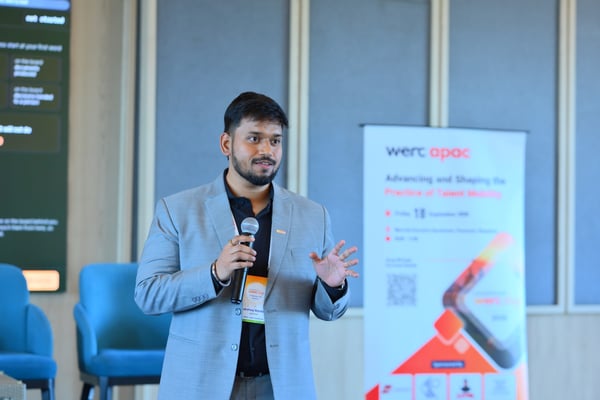
On 18 September 2026, WERC APAC brought its WERCshop series to Bengaluru, gathering around 120 mobility practitioners at the Marriott Executive Apartments for nine sessions across a full day.
AltoVita took part across the day and was also proud to sponsor the event. My colleague Apurva Poddar moderated a panel on a unified mobility ecosystem, while I participated in a session on how AI principles translate into controlled implementation in global mobility, and Akshay Yadav hosted one of the six roundtables.
The day opened with a question that everyone kept returning to:
“Bengaluru has the talent, but can mobility turn it into global capability, leadership and influence?”
Here is how the day answered that question.
1. Bengaluru has the talent - can mobility turn it into influence?
Unilever · GE Aerospace · Altair Global
The opening panel made the case that mobility adds the most value before the role, the candidate and the deadline are fixed. Unilever has moved mobility out of rewards and into its talent team. GE Aerospace brings mobility in as soon as a new position is being created.
Late involvement comes at a price. Moves arranged at the last minute carry hidden costs, tax exposure and permanent establishment risk, and immigration lead times do not bend to business deadlines.
"I would rather say that mobility is the table. Something that we need to build together."
2. From delivery centre to decision centre
Intuit · Sirva
Temporary accommodation is often the biggest pressure point. In a tight Bengaluru market, housing requests can arrive with as little as 48 hours' notice, which leaves little room to find the right option.
When deadlines are tight, mobility teams can still deliver by phasing the move. The employee can relocate first on a short-term per diem, with the family following later and a lump sum covering anything that cannot be settled before departure. Being clear from the outset about what fits within the deadline and what follows afterwards helps manage expectations on all sides.
Consistency matters just as much as speed. Briefing all movers together, rather than one by one, means everyone hears the same information and no one ends up comparing packages.
What mobility leaders really want
"Instead of being an execution team, we want to be at the decision centre of all this talent pipeline that we are moving."
3. From fragmented delivery to one mobility ecosystem
Moderated by AltoVita · Maersk · Visteon
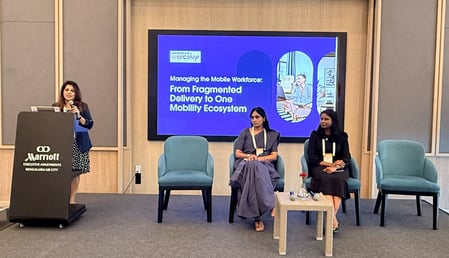 Apurva Poddar put five questions to the panel: who owns the journey, how handoffs work, what happens to data, what sits globally, and how you know the ecosystem is working.
One example stayed with the room.
A deployment in Southeast Asia slipped by weeks because no one owned the handoffs. The solution did not involve changing providers. It came from appointing a single journey owner and naming each transition point.
The panel also argued for connecting data rather than simply collecting it, so the employee enters their information once and every partner works from the same record. When CEOs judge a mobility programme, three measures matter most: experience, compliance and cost.
"Employees do not experience the providers, they experience the journey. Business leaders do not invest in the providers, they invest in the outcome."
Accommodation is one of the handoffs where this shows most clearly. When sourcing, requests and reporting sit in separate inboxes, the gaps become visible to the employee long before they show up in a report.
4. Speed without exposure: cross-border deployments
EY · Formula Group · AGS · Tredence
The cross-border deployment clinic was the most interactive session of the day, and much of the discussion came from the floor. One case involved a specialist working across four countries in a single year. The advice was to classify every trip by activity and duration, not by the label on the ticket. A fortnight every two months is a working arrangement, not business travel.
"Four countries does not mean four problems, but it also does not mean one answer."
5. AI without the theatre: setting mobility’s decision boundaries
Vestara · Agarwal Packers · Agentec
The panel was clear about where AI belongs.
According to the WERC survey, 17% of mobility work currently uses AI, expected to reach 40% within 36 months. Even so, when the room was asked whether they would act on an AI-generated visa opinion, no hands went up.
AI can handle scanning and reading documents, data extraction and questionnaires but the final decision stays with a person. Practical advice included writing an SOP for every AI use case: what the agent does, what it must never do, and where it hands over to a human.
"AI may inform the professional. It never becomes the professional."
6. From Guardrails to Go-Live: when the agent stopped, the room spoke up
Agentec · AltoVita
The session set out to run one relocation, London to Bengaluru, live on every phone in the room. Attendees picked their role, and the agent worked the file, drafting what it could and handing back every decision a person had to make.
Halfway through, the agent broke down. The pause turned into the session's most useful moment, as the room raised its two biggest blockers to AI: data privacy and sustainability.
On privacy, my view is simple: use the technology only to the extent you are comfortable sharing the information. On sustainability, much of the news about water consumption per prompt is not yet backed by proven research, so I believe the concern is best met with sensible use rather than avoidance.
For me, that is the real lesson. Relying entirely on AI isn't the answer, but ignoring it isn't either. The value comes from putting it in the right place, learning how it works and adapting it to save time, so we can focus on the work that matters most. The goal is not to hand our work over to AI, but to make the best of it.
"Use AI as far as you're comfortable sharing, and no further."
7. Global roles, Indian leaders: the two-way industry pipeline
Sterling Lexicon · Boeing · IKAN
With more core decision-making now based in Bengaluru, leadership needs to flow both ways, out of India and back into it. The panel described mobility as a mechanism rather than an outcome. Success is measured by the business objective met, the knowledge transferred and the local talent developed, not by a completed move.
The stage most programmes skip is the last one: is there a role waiting when the assignee comes home?
8. Will they move, perform and stay?
Graebel · bibha.ai · IOS · Globe Moving
This panel followed the employee through three stages: will they move, will they perform, and will they stay.
It also raised an uncomfortable gap: international assignees often receive extensive support, while domestic movers and middle managers are handed a lump sum and left to manage alone.
"How come expats get the love and affection, and the critical mass over here don't get that love and care?"
The realities of moving within India came through clearly. Landlords can ask for eight to ten months' deposit. Additionally, policies that require three quotes from moving companies leave employees waiting. Instead, having three pre-approved movers lets HR approve a relocation straight away. The recommendation from the floor was for shared, managed homes near the workplace, paid by the night rather than the month.
Roundtables: The Bengaluru Mobility Playbook
The day closed with six roundtables, one of them hosted by AltoVita, each tackling a single question. Three messages came through most strongly:
1. Make the true cost visible: Mobility needs to educate the business on the true cost of a move and belongs upstream in sales forecasting and planning.
2. Give employees one point of contact: Employees need one named case manager and one dashboard, not three or four systems.
3. Commit to the return: The business must commit to a role or redeployment before the person returns.
Five key insights from the day
- Join earlier. Bring cost and timeline estimates for shortlisted candidates before the business asks for them.
- Name one journey owner. Write down who owns each handoff between partners.
- Classify trips by what people actually do, not by what the booking says.
- Write the boundaries for AI. For one process, set out what the agent does, what it never does and where it hands over to a person.
- Plan for the family and the first weeks. Consider adding moving-in leave for every mover.
Continue exploring India's mobility landscape
Bengaluru and Hyderabad pointed in the same direction: technology can make the process predictable, but people make the experience.
Dive into our WERCshop Hyderabad recap and our Top 9 Trends Shaping Mobility and Corporate Accommodation in India for more insights from the market.